Why February Feels Like Failure (And Why That’s Not Your Fault)
On paper, February is month 2 of 12.
Twenty-eight days, sometimes twenty-nine. Nothing weird to see here.
But as we're currently finding out about a lot of things in this world, underneath "business as usual" it's a mess. A hot mess.
The calendar is no exception.
The one we use every day (the 12-month / 365-day Gregorian calendar) is a historical patchwork held together by tradition. It started as a Roman administrative project, months named after emperors and gods. Julius Caesar rebuilt it to stop the year drifting away from the seasons. Pope Gregory XIII tweaked it again in 1582 to fix the date of Easter, and in doing so deleted ten days in October to make the mathematics work. February became the dumping ground for whatever was left over: scraps from a system designed around power, taxes, governance, control. Our system of tracking time is not centered around the planet or our wellbeing.
I mean if we zoom out a bit, two of our months are named after dead Roman rulers: Quintilis renamed July for Julius, Sextilis renamed August for Augustus. The calendar is literally named after a pope and the whole thing looks like this: 31–28–31–30–31–30–31–31–30–31–30–31. There is no elegant underlying logic here.
So the calendar works for taxes and train timetables. But it doesn't really help to answer more fundamental questions: what is this part of the year actually for? What does now feel like and why does it feel like this? What is this moment asking of us?
The current calendar says it's Q1. Cool. But Q1 doesn't know that in the northern hemisphere right now, the light is weak, the soil is cold, and every non-human biological system is running on minimal output (because that's the sensible thing to do when it's been gray and cold for what feels like forever). Trees aren't failing their annual goals. They're doing exactly what winter demands, which is essentially nothing, and doing it with complete commitment. Meanwhile I don't know about you but I'm over here on most days trying to perform, and concluding that maybe I'm the problem.
Our year has been flattened into twelve equal-looking blocks and we decided every week should behave the same. We call it consistency. Biologically it's more like running the same workout at sea level and at altitude, then blaming our lungs.
We're living inside a system that never made the most important actor (the planet itself) the authority on how the calendar should work. We don’t live in a spreadsheet; we live on a rock hurtling through space: a crazy, beautiful, intricate, fragile world. Some latitudes experience relatively stable climates. Others get the full drama of the planet’s tilt and orbit: long nights, long days, sharp seasonal shifts. The year does not land the same way in Stockholm as it does in Singapore, but our calendar behaves as if it does.
Psychology and biology both have language for what happens when we live this way: circadian disruption, seasonal energy variation, social jetlag, which basically means we live in a chronic misalignment between our internal biological clock and the external schedule modern life imposes.
I’ve watched it play out in myself and in people around me: when we ignore light cycles and seasonal rhythms, anxiety creeps up, motivation drops, and a quiet something is wrong with me narrative settles in.
Older cultures, without data, watched the sky and felt their world and then acted accordingly. The Celts marked Imbolc at the start of February, not as celebration but as acknowledgment: the world is beginning to stir, but it isn't awake yet. Be patient. The Chinese lunisolar calendar began its new year just days ago, anchored to the second new moon after winter solstice (a genuine astronomical event, not an arbitrary line in a spreadsheet). Across different traditions, the message is the same: this moment in the year has instructions.
Somewhere between the industrial revolution and the smartphone notification, we lost the ability to live in sync with our natural rhythm.
How the Earth Calendar Came Out of This Mess
Ever since COVID, I've kept noticing that the same stretch of winter brought the same thoughts, the same fatigue, the same urge to strip everything back. Time stopped behaving like a straight line and started looking suspiciously like the movie Arrival: revisiting the same coordinates with slightly more information each time, and realising that maybe our linear calendar is not supporting the cyclical growth we are meant to embody.
My brain then did what it always does when a structure feels wrong: redesign the structure.
The question became: what would a calendar look (and feel) like if it was built around nervous systems, light, seasons, our planet... but still worked alongside the one we already use to run our lives?
Enter: The Earth Calendar.
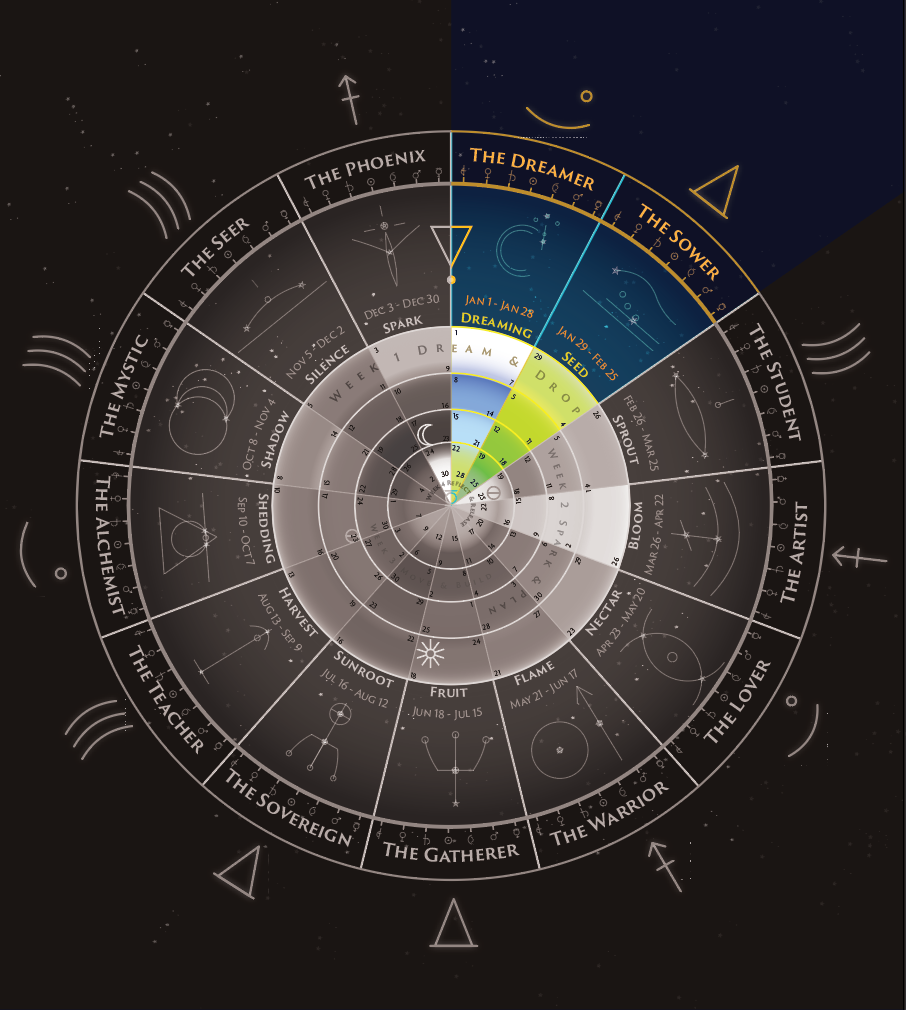
In the Earth Calendar (EC for short) the year is divided into 13 moons, each 28 days, which ensures 4 weeks of 7 days each. December 31st becomes a Day Out of Time, sitting outside the cycle entirely. Each Moon carries an element and an archetype: Dreaming, Seed, Sprout, Bloom, Nectar, Flame, Fruit, Sunroot, Harvest, Shedding, Shadow, Silence, Spark. Inside every Moon, the same four-week rhythm repeats: Dream & Drop → Spark & Plan → Move & Build → Reflect & Release. The planetary weekdays: Moon, Mars, Mercury, Jupiter, Venus, Saturn, Sun layer on top as the daily tone.
The Earth Calendar answers a different question: given where we actually are in the year, what is this phase suited for? Because “do your taxes” is not the same kind of instruction as “rest” or “build” or “let go”.
Where We Are Right Now
As I write this, we're in Seed Moon, the first Earth Moon of the year. Its job is less glamorous than “fresh start” and more grounded: choosing what actually goes in the soil.
We're in Week 4: Reflect & Release. The last exhale before the wheel turns again.
This is the week you look back at what you thought Seed Moon would be, notice what moved and what didn't, and clear enough space for the next Moon to have room. It's not about forcing productivity at the bottom of winter. It's honest stock-taking. Gentle subtraction.
Next comes Sprout Moon, the first genuine stirring. The lemon tree dropping leaves on my terrace right now will be pushing new growth in a few weeks. Not because it set better goals. Because the conditions will change and it's wired to respond.
So are we.
You don't have to feel ready. You just have to know where you are.
That’s what the Earth Calendar is for. Every Thursday on Jupiter’s day (traditionally associated with expansion, wisdom, and teaching), I’ll be here: tracking where we are in the wheel, what the current Moon is asking of us, and occasionally going deeper into the architecture of the system itself.
This post is the first marker on that map.
Stéphane, Seed Moon 2026